Exquisite Chinese Cinnabar-Style “Nine Dragon Wall” Sculpture
Exquisite Chinese Cinnabar-Style “Nine Dragon Wall” Sculpture
$5,000.00 Original price was: $5,000.00.$3,500.00Current price is: $3,500.00.
- Description
- More Details
- Cultural and Historical Significance
Description
- Period: Mid-20th Century Nine Dragon Wall Sculpture
- Primary Motif: The “Nine Dragons Taming the Waters” (Auspicious Imperial Protection).
- Artistry: Deeply undercut high-relief carving (front); Gilded Xingshu (running script) calligraphy (back).
- Materials: Carved cinnabar-lacquer composition over a reinforced core; Custom black-lacquered hardwood base.
- Signature: Inscribed and signed by the Master Wang Zuyao (王祖耀书).
- Condition: Museum-Grade. The cinnabar retains a deep, lustrous saturation; gold calligraphy is crisp and luminous; no losses to the intricate high-relief scales or fins.
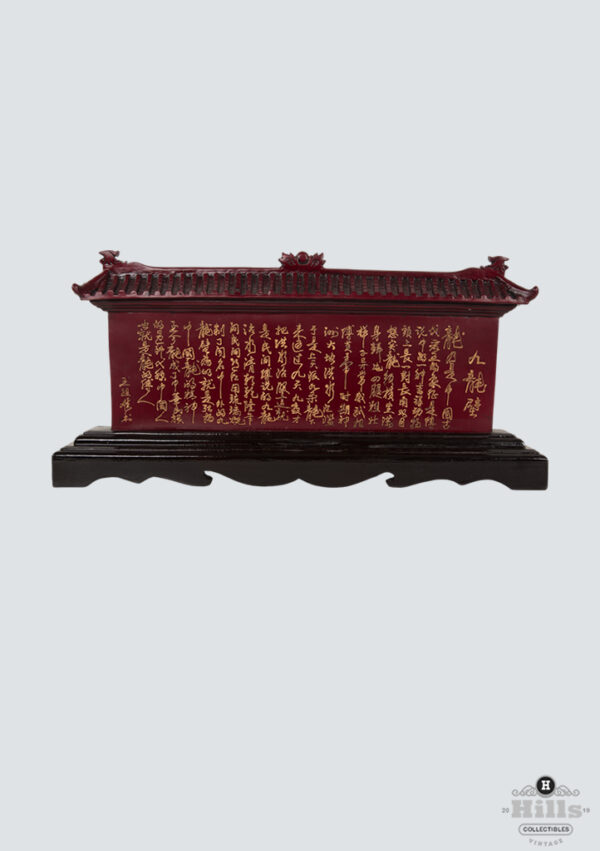
INSCRIBED:
龙乃是中国古代帝王的象征,是传说中的一种吉祥动物。头上长一对长角,双目怒睁,龙须横生,满身鳞片,四腿粗壮,样子异常威武,相传黄帝时期,神州大地洪水泛滥,于是上天派九条龙下来,通过九天九夜才把洪水治服,这就是民间传说的九龙治水。清朝乾隆年间民间巧匠用琉璃烧制了闻名中外的九龙壁,为的就是弘扬中国龙的精神,至今龙成了中华民族的另一种代称,中国人也就是龙的传人。
Exquisite Chinese Cinnabar-Style “Nine Dragon Wall” Sculpture
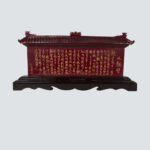
A masterful dual-sided tabletop replica of the legendary Jiǔ Lóng Bì (Nine-Dragon Wall). This piece embodies over 2,500 years of Chinese imperial symbolism, rendered in vibrant vermilion cinnabar-style lacquer. Featuring high-relief sculptural work on the primary face and professional gold-leaf calligraphy on the reverse, it sits atop a custom scalloped black lacquer hardwood pedestal.
Detailed Specifications
- Primary Motif: The “Nine Dragons Taming the Waters” (Auspicious Imperial Protection).
- Artistry: Deeply undercut high-relief carving (front); Gilded Xingshu (running script) calligraphy (back).
- Materials: Carved cinnabar-lacquer composition over a reinforced core; Custom black-lacquered hardwood base.
- Signature: Inscribed and signed by the artist Wang Zuyao (王祖耀书).
- Condition: Museum-Grade. The cinnabar retains a deep, lustrous saturation; gold calligraphy is crisp and luminous; no losses to the intricate high-relief scales or fins.
Cultural and Historical Significance
The Imperial Spirit Wall The Nine-Dragon Wall (Jiǔ Lóng Bì) is the ultimate architectural expression of the Emperor’s divine mandate. Historically, these massive “spirit walls” were placed at the entrances of palaces (such as the Forbidden City and Beihai Park) to deflect malevolent spirits, which—according to tradition—could only travel in straight lines.
Symbolism of Nine and Five In Chinese numerology, the number 9 represents the Yang (supreme) principle and the “apogee of power.” In the Ming and Qing dynasties, five-clawed dragons were reserved exclusively for the Emperor. This model captures the ferocity of the “Nine Sons of the Dragon,” each representing different facets of authority: from the power to control floods to the ability to bring life-giving rain to the empire.
The Diplomatic Gift Tradition During the mid-20th century, highly detailed architectural models like this were produced as prestigious diplomatic gifts. These pieces were commissioned to represent the “Land of the Dragon” to foreign dignitaries, symbolizing a bridge between China’s ancient imperial history and its modern cultural identity. The inclusion of the calligrapher’s name, Wang Zuyao, suggests a piece of higher pedigree than standard exports, likely intended for a recipient of official status.
Condition and Curatorial Notes
The piece is in exemplary condition. The cinnabar lacquer (the traditional color of luck and protection) shows no signs of “blooming” or fading. The calligraphy remains pristine, and the black lacquer base has developed a rich, hand-rubbed patina.
Front: Nine Dragons in Dynamic High Relief
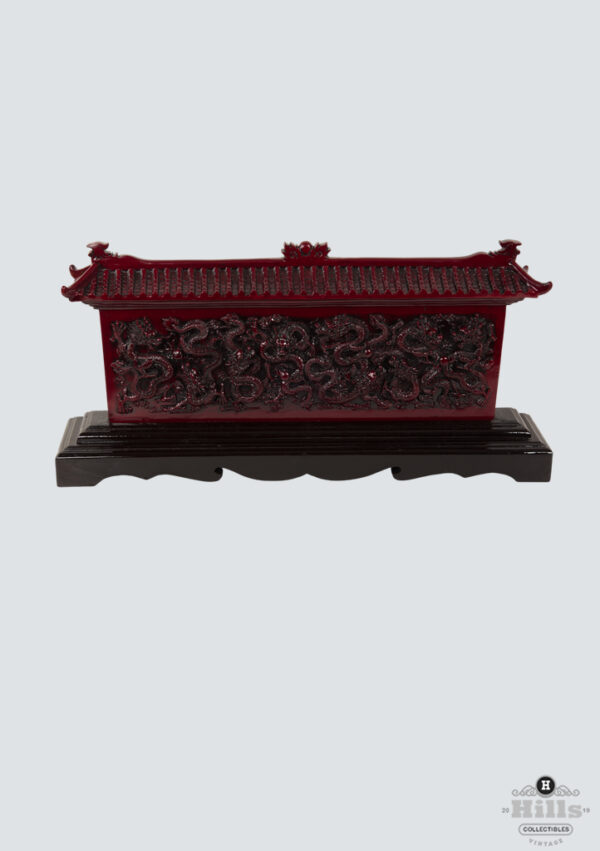
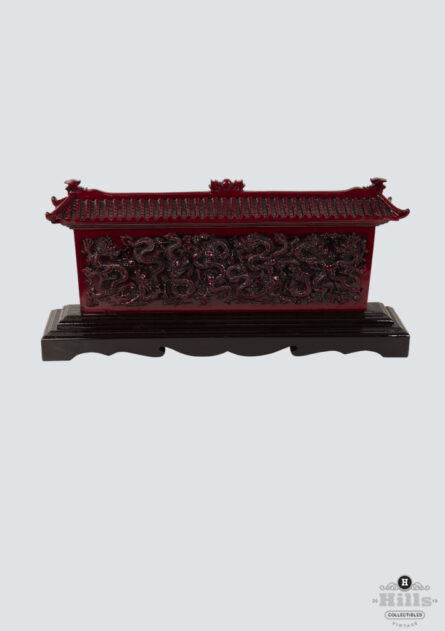
The primary face (dragon side) explodes with life: nine powerfully sculpted dragons coil and writhe in perfect high-relief carving across the cinnabar panel. Each dragon is individually rendered with flowing manes, scaled bodies, pearl-clutching claws, and flaming auras representing the nine sons of the Dragon King and the complete spectrum of imperial authority. Clouds, waves, and flaming pearls swirl between them, creating a sense of perpetual motion. Surmounting the panel is a classic Chinese tiled roof with upturned eaves and ornate dragon-finial ridge ornaments, exactly mirroring the architectural details of the historic walls. The entire composition sits proudly on its original black lacquered wooden base, evoking the grandeur of a palace screen.
Back: Master Calligraphy Inscription in Pure Gold
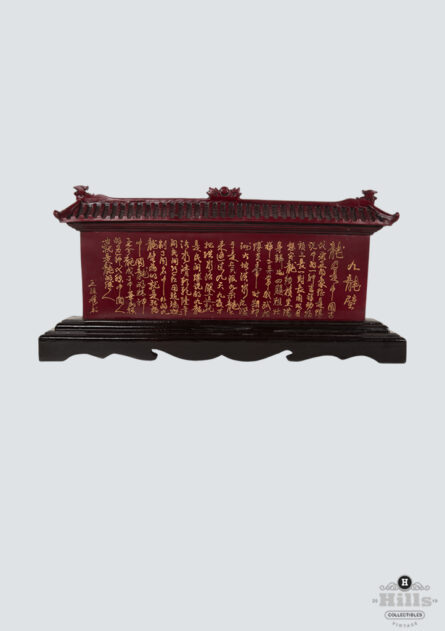
The reverse side is equally magnificent, transforming the plaque into a scholarly and artistic treasure. The entire panel is covered in elegant, flowing gold calligraphy against the rich cinnabar ground. Dominating the right side is the bold title 九龍壁 (Jiǔ Lóng Bì – Nine Dragon Wall). The inscription continues in classical Chinese script as a poetic ode celebrating the dragons’ mythical power: their role as protectors of the nation, symbols of the emperor’s heavenly mandate, bringers of rain and prosperity, and eternal guardians of harmony between heaven and earth. References to the “land of the dragon” and the enduring spirit of the Chinese people are woven throughout. The composition culminates in the artist’s signature and seal: 王祖耀书 (Written by Wang Zuyao), confirming the work of a master calligrapher and adding layers of connoisseurial value. This dual-sided design—dragons on one face, gold calligraphy on the other—is exceptionally rare and elevates the piece far beyond standard decorative models.
Nine Dragon Wall Sculpture Comparable Sales
Market analysis for high-relief cinnabar and related Nine-Dragon models indicates a strong appetite for signed, architectural pieces:
- Bonhams San Francisco (2007): A large carved model of a Nine-Dragon Wall (wood core, ivory relief) sold for US$12,000. While that piece utilized ivory, the artistry and “Wall” format are the primary value drivers.
- Sotheby’s Important Chinese Art (2021): A carved cinnabar “Nine Dragon” box from the Qianlong period (18th C.) fetched £40,320. While older, it demonstrates the high collector demand for the Nine-Dragon motif in cinnabar.
Translation of the Gold Inscription
“The dragon is an auspicious symbol of the Chinese nation and a legendary creature… During the time of Emperor Bo Mo, these dragons used their divine power to subdue the great floods… In the Qianlong period of the Qing Dynasty, the people fired glazed tiles to create the world-famous Nine Dragon Wall… to promote and glorify the dragon spirit. We are the descendants of the Dragon.” — Inscribed by Wang Zuyao
Exquisite Chinese Cinnabar-Style “Nine Dragon Wall” Sculpture
$5,000.00 Original price was: $5,000.00.$3,500.00Current price is: $3,500.00.