19th Century Zulu iNhlendla Prestige Spear Staff – All-Wood Arrowhead Variant
19th Century Zulu iNhlendla Prestige Spear Staff – All-Wood Arrowhead Variant
$20,000.00 Original price was: $20,000.00.$15,000.00Current price is: $15,000.00.
- Description
- Historical Context
- THE ANATOMICAL & COMPOSITIONAL ANALYSIS
Description
Item: Zulu iNhlendla Prestige Staff (All-Wood Arrowhead / Spear Form Variant)
Origin: Zulu Kingdom, Southern Africa
Period: 19th Century (Anglo-Zulu War Era, c. 1870s–1880s)
Provenance: Surviving period inscription: “Kaffir Chiefs Spear Natal, Mr Hughes.” Ex-Private Collection, UK Market
Documentation & References: Featured on TribalArt.com (iNhlendla Series – Part 2: Prestige Zulu Spear Staff Variant), documented in YouTube visual analysis, and cited in ethnographic literature.
This is not a walking stick.
It is a royal weapon of the spirit.
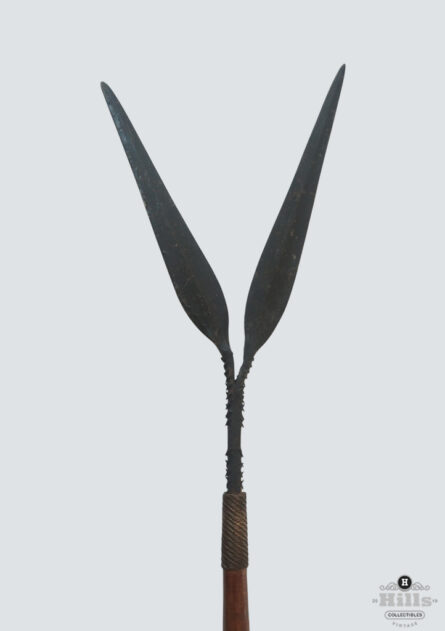
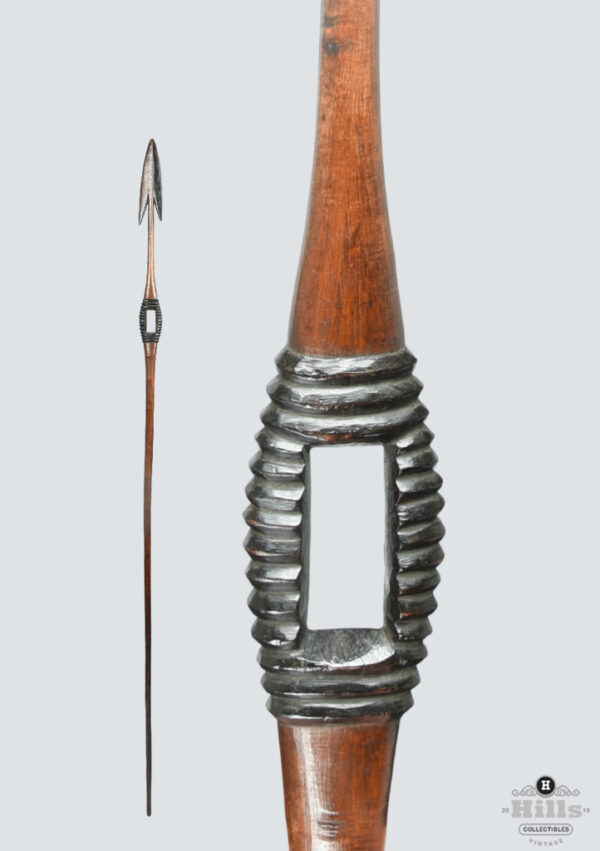
In the stratified hierarchy of the 19th-century Zulu Kingdom, authority was never merely announced, it was embodied. While the short iklwa ruled the battlefield, the elongated inhlendla ruled the council, the ceremonial ground, and the ancestral continuum. This rare all-wood variant, carved as a complete skeuomorphic spear with a meticulously formed arrowhead terminal, stands among the purest expressions of ubukhosi — chieftainship itself.
Historical Context: A Symbol of Absolute Rank
Emerging during the meteoric consolidation of the Zulu state under legendary King Shaka kaSenzangakhona and refined under his successors, the inhlendla was reserved exclusively for the king, high-ranking indunas, and those granted explicit royal dispensation. Anthropologist A.T. Bryant recorded it as a weapon of status rather than war. Where the army carried iron, the elite carried wood that looked like iron — a deliberate soft representation of hard power. To carry one was to declare that one’s authority was so complete it required no actual metal edge to be understood.
1. The Skeuomorphic Winged Blade Finial (The Crown)
-
Architecture: Masterfully sculptured from a single block of timber, the head replicates the flared, barbed geometry of the classic iNhlendla iron blade.
-
Symbolic Metaphor: By rendering a military weapon into a smooth, organic form, the carver transformed a tool of warfare into a refined, permanent symbol of judicial and ancestral governance.
2. The Central Aperture & Structural Work
-
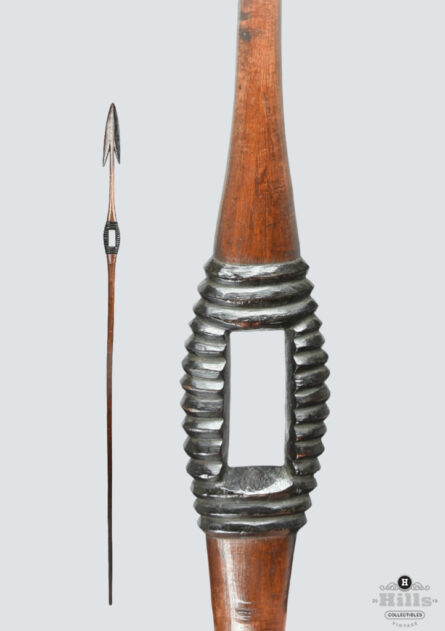
The “Window” Feature: Below the terminal blade, the staff incorporates a delicately carved central aperture or openwork section. In Zulu cosmology, this central “portal” demonstrates the woodcarver’s absolute mastery over the grain while acting as a symbolic opening for ancestral oversight (Amadlozi).
-
Proportions & Balance: Designed with exaggerated length, the staff functioned as an elevated visual standard, allowing a leader to be identified instantly over dense crowds during public assemblies and court gatherings.
3. The Timber & Sacred Patina
-
Material Selection: Carved from extremely dense, sacred indigenous hardwood—typically Red Ironwood (umSimbithi) or Stinkwood—chosen for its weight, resilience, and spiritual resonance.
-
Surface Condition: The wood exhibits a deep, hand-rubbed oil patina built up through generations of ritual handling, preserving authentic micro-checking along the longitudinal grain lines without compromising structural integrity.
A Sculpture of Negative Space
The great artistic achievement of this variant lies in what the carver has removed.
The central aperture interrupts the solidity of the arrowhead terminal and turns the object into an exercise in positive and negative space. From one angle, the spearhead appears powerful and dense; from another, light passes through its centre, dissolving the mass and revealing the intelligence of the composition.
This is where the iNhlendla transcends the category of “staff.”
It becomes sculpture.
The opening is not merely decorative. It creates tension between strength and fragility, weapon and symbol, mass and void. The terminal appears simultaneously ancient and modern—its geometric abstraction possessing a sculptural purity that would be entirely at home beside the great works of twentieth-century modernism.
Yet this form was not created as modern art.
It was created within the visual and political language of the Zulu world.
That is what makes it so compelling.
The “Soft” Weapon of Absolute Authority
The all-wood iNhlendla represents a profound paradox.
It is a weapon without a cutting edge.
A spear without a point of iron.
A martial symbol incapable of ordinary warfare.
And precisely for this reason, it becomes an even more powerful statement of prestige.
The staff does not need to prove its authority through utility. Its bearer does not need to draw blood to communicate power. The form of the weapon alone is sufficient.
In this sense, the all-wood iNhlendla can be understood as the Zulu equivalent of a royal sceptre: an object whose physical form embodies the authority to command.
It is power made visible.
The iNhlendla Series Context
This all-wood spear form represents the second major variant in the classic iNhlendla typology:
- Swallow-tail metal blade — the royal form most strongly associated with the visual authority of the Zulu elite
- All-wood spear form with carved arrowhead terminal — this piece
- Dramatic all-wood barbed / winged uNhlongweni — a more elaborate prestige form incorporating sculptural motifs and exaggerated geometry
Together, these forms demonstrate the extraordinary range of the Zulu prestige-staff tradition. Though their silhouettes differ, they share the same essential purpose: to transform an object carried in the hand into a visible extension of rank, legitimacy, ancestral connection, and authority.
The iNhlendla was, in this sense, far more than a staff. It was a portable constitution of power.
Institutional Comparables
Authentic examples of this exact all-wood arrowhead-terminal form are held in the British Museum (notably Af1936,1015.1 and related accessions) and appear only rarely on the market. Surviving specimens of this purity and presence are exceptional.
This is the wooden scepter of a vanished court; a 19th-century Zulu prestige inhlendla in its purest, most spiritually charged expression.
Featured and discussed in depth at: Prestige Zulu Staff: Royal Symbol of Ubukhosi Power
19th Century Zulu iNhlendla Prestige Spear Staff – All-Wood Arrowhead Variant
$20,000.00 Original price was: $20,000.00.$15,000.00Current price is: $15,000.00.